The short answer
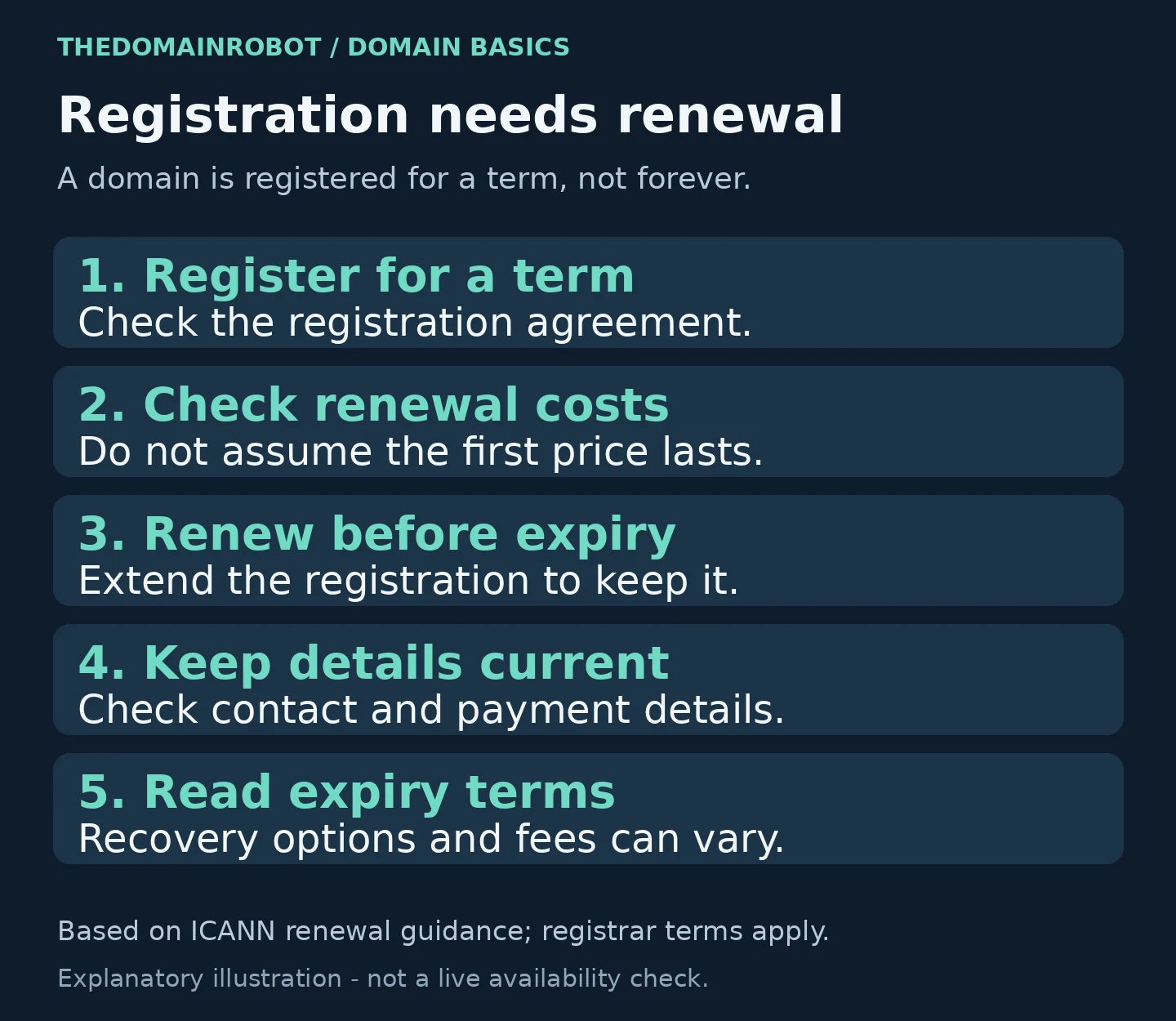
No. A domain name is not a one-time purchase. When you register one you get the right to use it for a fixed period, usually one year by default and often up to several years, and you must renew it to keep it. If you stop paying, the registration expires and the name can eventually become available for anyone to register.
Think of it as a subscription or a lease, not ownership for life. The same principle is behind every expired domain we list.
Need the domain first?
Runs the same live check as the front page. If it is taken we will show you when it expires.
What you pay for
- Registration. The first term. Some registrars price the first year low as a promotion.
- Renewal. The recurring fee to extend the registration. It can be higher than the first-year price, so look at the renewal price before you register.
- Extras. Privacy protection, email, hosting and SSL certificates are separate products at some registrars and included at others.
ICANN's expired-registration policy requires registrars to make renewal fees, post-expiration renewal fees (if different) and redemption or restore fees reasonably available at the time you register a generic-TLD name. Look for them on the registrar's site or in the registration agreement. Renewal prices also depend on the TLD; see what a top-level domain is.
What happens if you do not renew
ICANN's Expired Registration Recovery Policy sets minimum rules for generic TLDs. Your registrar's own terms may add more, and country-code TLDs follow local rules.
- Reminders before expiry. Registrars must send at least two notices, about one month and about one week before expiration, to the registrant's email address on record.
- Expiry. After expiration, registrars may delete the registration at any time, subject to other policies. Some offer an auto-renew grace period of between 1 and 45 days in which you can still renew, sometimes for a fee. ICANN warns that in this period the name may become available to third parties, depending on the registrar's terms, and may be auctioned.
- DNS interruption. Where the registry permits it, the registrar must interrupt the existing DNS resolution path from expiry until deletion if deletion occurs within eight days. For later deletion, interruption must cover at least the last eight consecutive days during which the expired registration is renewable. Your existing website and email may stop working; an expiry page may appear instead.
- Reminder after expiry. If the name is not renewed or deleted within five days after expiration, the registrar must send at least one more notice with renewal instructions.
- Redemption Grace Period. Generic-TLD registries (except sponsored ones) must offer a 30-day Redemption Grace Period after deletion. The name cannot be transferred and does not resolve, but your registrar can restore it, usually for an extra fee.
- Release. After the registry releases the name, someone else may register it if it remains available. Our posts on the life cycle of a domain name and expired domains go through the stages in detail.
Restoring is usually more expensive than renewing on time, because of the restore fee. Renew before the expiry date.
How to avoid losing your domain
- Turn on auto-renew at your registrar and keep the payment method valid. Keep billing details current and monitor renewal notices: automatic renewal and payment can still fail.
- Keep your contact details current. Reminders go to the registrant email on record. ICANN also recommends giving a secondary email that is not on the domain itself, since the domain's own email stops working once DNS is interrupted.
- Register for several years if you are sure you will keep the name. You still renew at the end of the term.
- Note the expiry date somewhere outside the registrar's emails.
- Read the registrar's terms on grace periods, restore fees and auctions of expired names.
Is there anything like lifetime ownership?
Not under the ICANN registration model for generic TLDs: registrants hold a registration for a term and must renew it. Offers that call themselves "lifetime" are specific to a seller and its terms, so read what is actually promised. Whoever holds the registration is shown in the registration data; our post on WHOIS lookup tools shows how to check a name's expiry date where it is public.
FAQ
Do I pay once for a .com?
No. A .com is registered for a period and renewed. The price and the number of years depend on the registrar.
Can someone else take my domain the day it expires?
Generally not on the same day. For generic TLDs, the registrar must allow you to renew after expiration, and there is a 30-day redemption period after deletion. But some registrars may sell or auction expired names during their own grace period, so renew early.
Is the domain mine if I paid for it?
You are the registrant, with the right to use it and to transfer or sell it while the registration is active. See how to sell a domain name and how to transfer domain ownership.
Are there hidden costs?
The main ones are renewal prices above the first-year price, paid privacy, and restore fees. All can be checked in the registrar's fee pages before you register.