The short answer
It depends on which question you mean. If you ask whether a domain keeps working after its owner stops paying, the answer is usually no: the website, email and other services on it stop working once the registrar or registry takes the name out of the DNS, and the exact moment depends on the registrar. If you ask whether an expired domain is still worth buying for a new site, the answer is: sometimes, if the name has a clean history and fits what you plan to build.
The sections below cover both questions.
Need the domain first?
Runs the same live check as the front page. If it is taken we will show you when it expires.
Does an expired domain keep working?
A registration is valid for a fixed period, typically between one and ten years. ICANN states that to keep using the name and the services tied to it, such as a website or email, you must renew it with your registrar before it expires. If you do not, you risk losing it for a short time or for good.
What visitors see right after the expiry date depends on the registrar. Some registrars switch the name off or show a parking page quickly. Others keep it running for a while. A domain can also be set to a hold status that stops it from resolving in the DNS; ICANN lists this as clientHold and says it is typically used for legal disputes, non-payment, or when a domain is subject to deletion. So a website can go offline before the name is released to the public, and you should not count on a lapsed domain continuing to work.
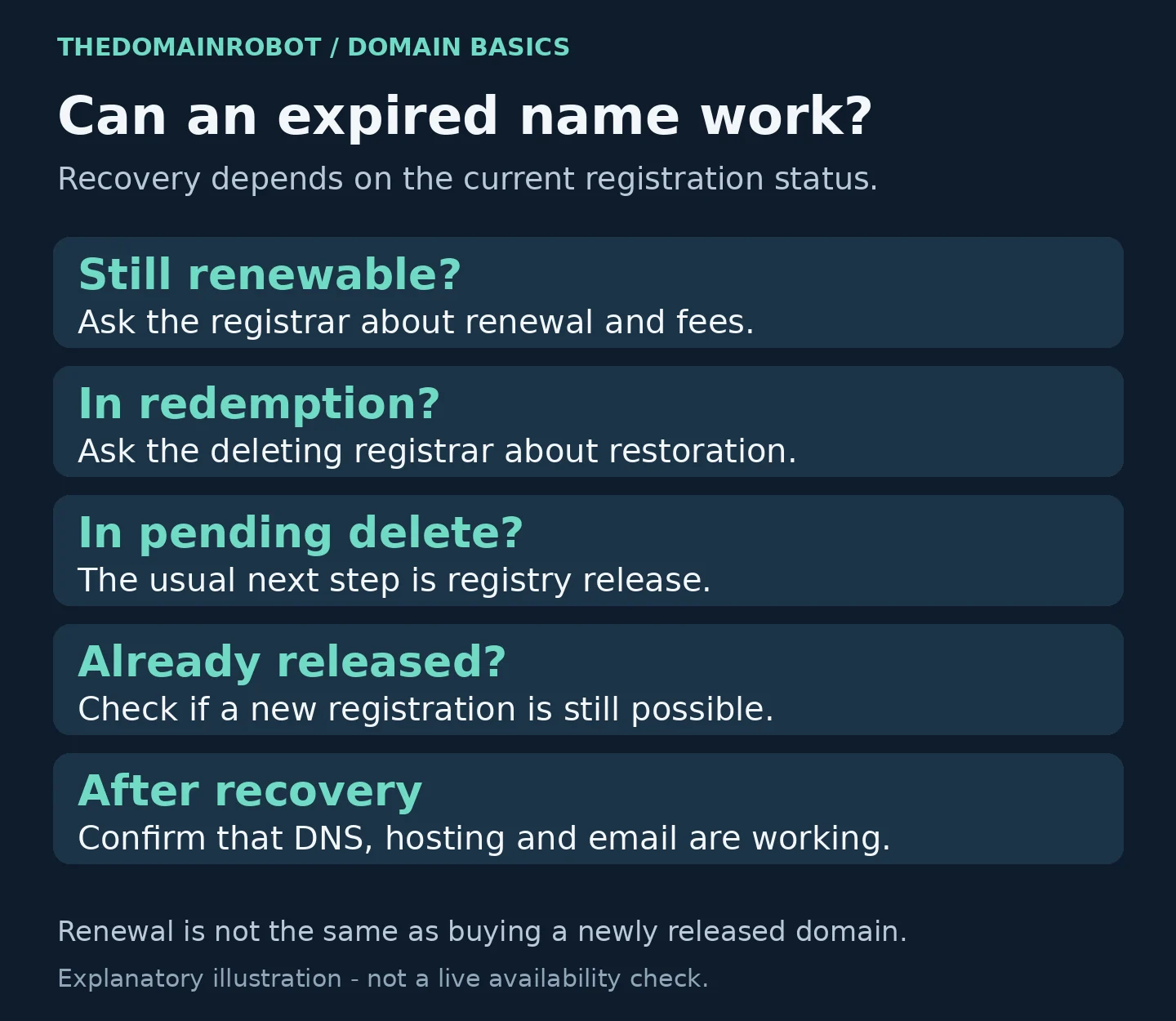
The owner can generally still renew during the early stages, but fees and options vary by registrar, so the registrar's terms are what count. ICANN's Expired Registration Recovery Policy sets some minimum rules: registrars must send two renewal reminders before expiry (about a month and about a week ahead), and if a registration expires and is deleted, at least one more notice within 5 days that explains how to restore it. Reminders go to the registrant's email address, which is why it must be kept current.
What happens to the name afterwards
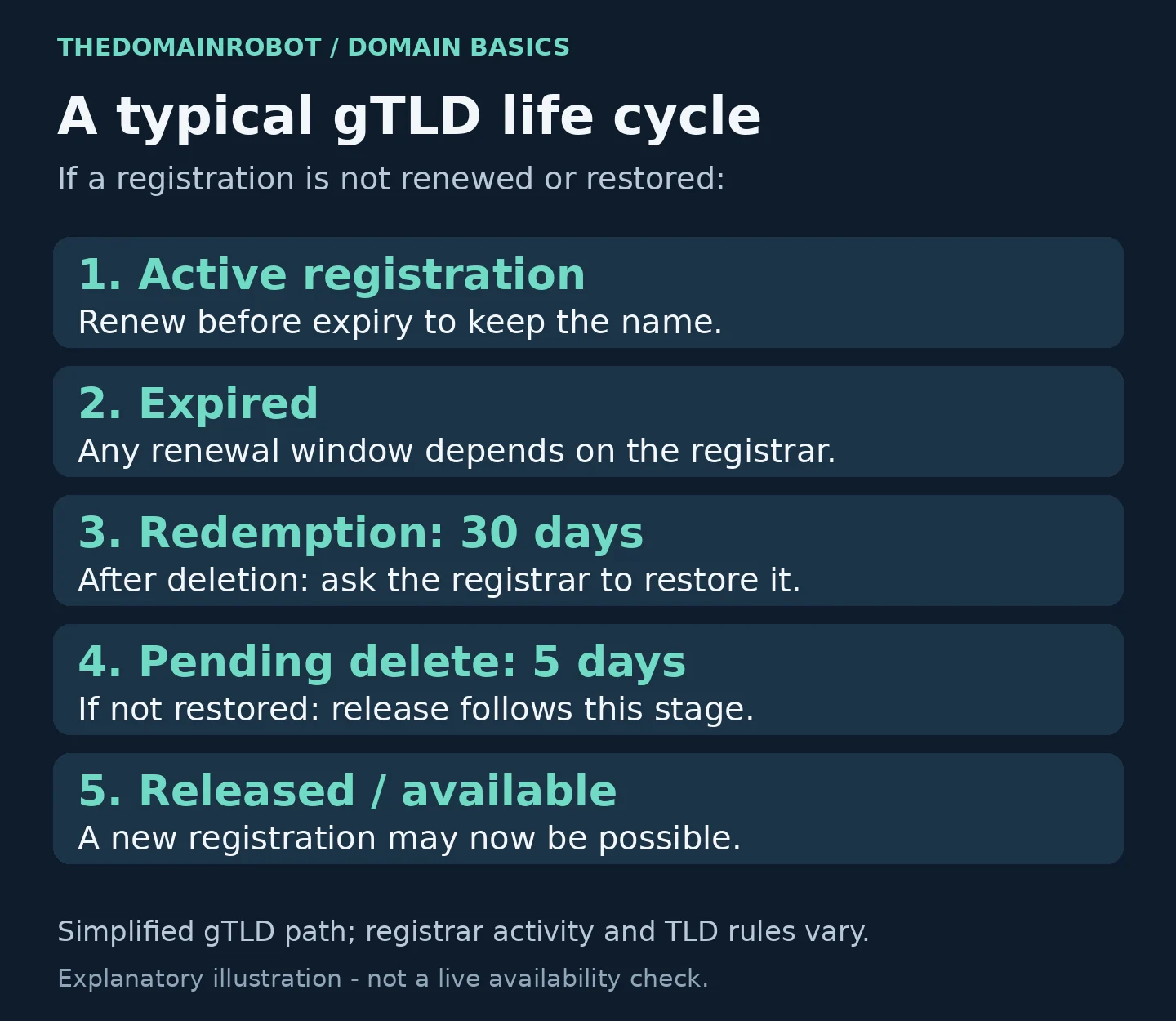
If nobody renews, the name moves through the stages we describe in the life cycle of a domain name:
- Auto-renew grace period. Some registrars offer a period of 1 to 45 days after expiry in which the owner can still renew. Depending on the registrar's terms, the name may even be offered to third parties or auctioned during this time.
- Redemption grace period. For generic TLDs, a 30-day window after deletion in which the registry will not transfer the name and the owner can restore it, normally for an added fee.
- Pending delete. A short stage, around five days according to ICANN, after which the name is purged from the registry database.
- Released. The name is available to register under the registry's rules. Some names are registered again within moments, often through backorder services.
Country-code TLDs set their own timings; for example, a registry may release names on a fixed weekday. Check the registry's own rules for any extension outside the common generic ones. For the full picture, see expired domains explained and our guide to dropped domains.
Do expired domains still work for SEO?
Here is the second meaning. A common reason to buy an expired domain is to get a head start: links that other websites placed years ago may still point at the name, and search engines may still know it. That can help, but it is not a guarantee, and it is not the shortcut it was sometimes sold as.
- Links lose value when the topic changes. Backlinks from sites on a related subject are worth keeping; unrelated or spammy ones are not.
- Old reputation can be a burden. If the previous site was spammy or penalised, the name may start with a handicap rather than an advantage.
- Search engines look at what you publish. A name does not rank by age alone. The content, its usefulness and its fit with the old links matter.
- There is a policy risk. Google's spam policies define expired domain abuse as buying an expired domain and repurposing it mainly to manipulate search rankings with content that provides little or no value to users. Its examples include affiliate content on a site previously used by a government agency and casino content on a former elementary school site. A real site on a fitting topic is a different thing from that.
So an expired domain can still be worth having, but the decision should rest on the name and the project, not on a hope that old authority will carry a weak site. More on the upsides and downsides is in why you should buy expired domains.
How to check an expired domain before you buy
- Confirm it is really available. Run a WHOIS lookup. A name that has expired but not dropped may still be renewed by its owner. Browse names that are available to register on our expired domains list.
- Check the history. Look at old snapshots of the site in the Internet Archive and see whether the content was legitimate and on a consistent topic.
- Check the backlinks. Use an SEO tool to see who links to the name and whether those links come from real, relevant sites.
- Check trademarks. A name that matches an existing mark can lead to a dispute.
- Check the name. Easy to spell, say and remember, with an extension that suits your audience.
If you are still deciding what to do with a name after registering it, our guides on redirecting an expired domain and transferring expired domain ownership cover the practical next steps.
FAQ
Will my website work if my domain expires?
Not for long. Once the registrar or registry stops the name resolving, the site and email on it stop working. Renew with your registrar as soon as possible; the options and fees after expiry depend on its terms.
Can I still renew a domain after it expires?
Often yes, during the registrar's grace period or the redemption period, but renewing late can cost more. If you cannot renew it yourself, contact the registrar. ICANN does not have the authority to transfer domain names back to you.
Do expired domains still have backlinks?
They can. Links on other sites do not disappear when a domain expires, but sites may remove or fix them over time, so the number can drop.
Is it legal to buy an expired domain?
Registering an available name is allowed. You can still run into trademark claims if the name matches someone else's mark, so check before you build on it.