What is a dropped domain?
A dropped domain is a domain name whose registration has been deleted from the registry after the owner stopped renewing it. Once the name has dropped, it is available again and anyone can register it at a registrar. People also call these names deleted domains or, more loosely, expired domains.
Dropped domains attract buyers because a name that used to have a website may still have links pointing at it, and a good name is hard to find among the ones that are still taken. They also carry risk, because you inherit the name together with its past. This guide explains how a name drops, what to check before you register one, and the ways to buy.
Need the domain first?
Runs the same live check as the front page. If it is taken we will show you when it expires.
How a domain drops
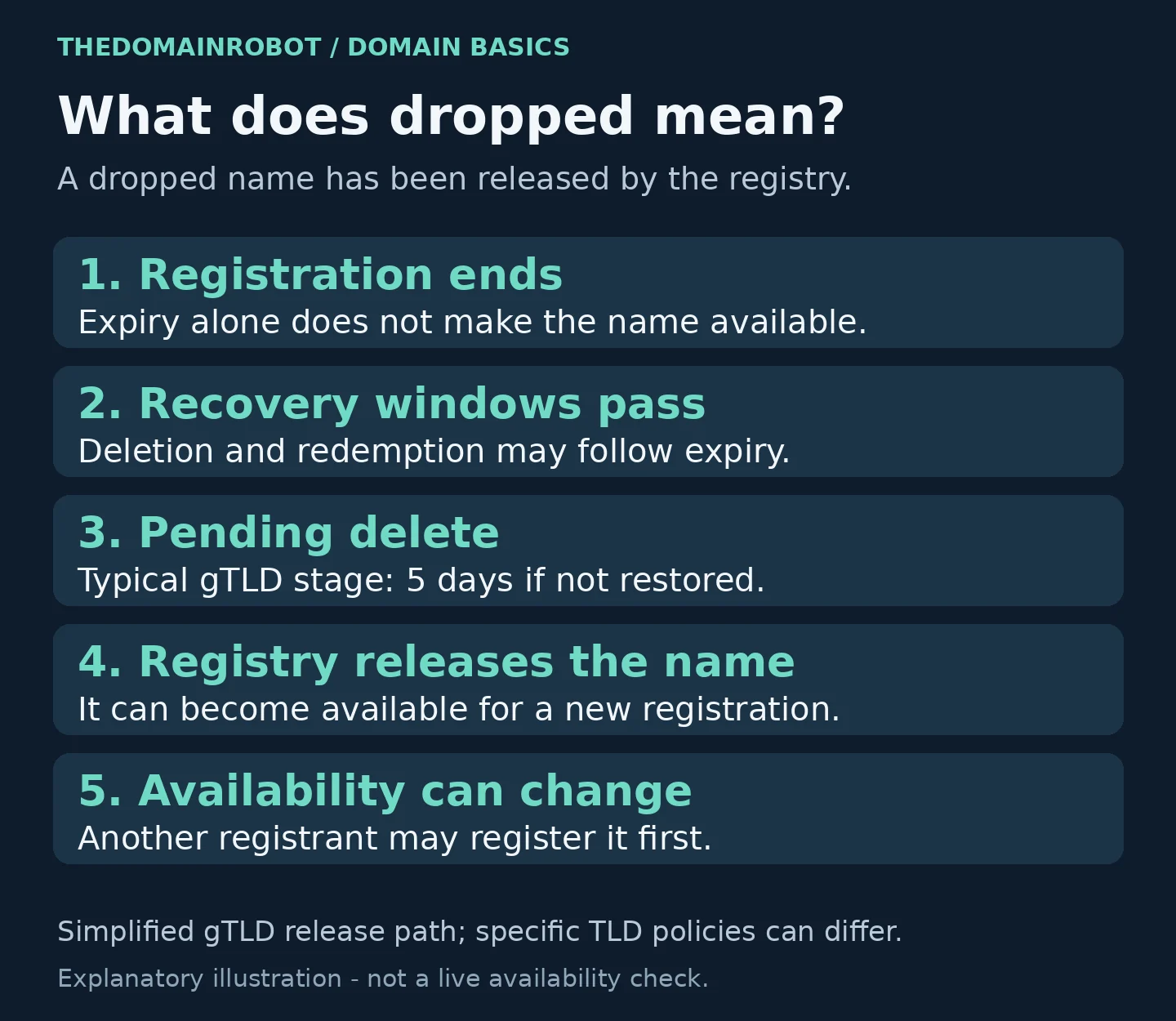
A domain does not become available the moment it expires. It passes through several stages first, and the original owner can usually get it back during most of them. Our guide to the life cycle of a domain name covers every stage; the short version is:
- Expiration. The owner does not renew before the registration period ends. ICANN policy requires registrars to send renewal reminders before expiry, about one month and about one week ahead.
- Auto-renew grace period. Some registrars keep the name for a period of 1 to 45 days after expiry during which the owner can still renew. The length and fees depend on the registrar.
- Redemption grace period. For generic TLDs such as .com, the registry holds the deleted name for 30 days. The owner can still restore it, usually for an extra fee.
- Pending delete. After the redemption period the name stays in pending delete for a few days (ICANN describes about five calendar days) and is then purged from the registry database.
- Dropped. The name is available for registration under the registry's rules.
Two things follow from this. First, a name that merely looks expired is often not available yet, because the owner may still be able to renew it. Second, country-code domains follow their own rules and timings, so check the registry's policy for any extension other than the common generic ones. The difference between expired, expiring and dropped is explained in more detail in our expired domains overview.
Why people want dropped domains
- A better name. Short, memorable or keyword-rich names are mostly registered already. A dropped name is another chance at one.
- Existing backlinks. If other sites linked to the old website, some of those links may still point at the domain. They can help a new site on a related topic, but there is no guarantee.
- Residual visitors. Some names still receive visits from old links or from people who remember them.
- Price. If a dropped name remains available, it can be registered directly rather than bought from a current registrant. Compare current registration and renewal prices before paying.
We go deeper on the benefits in why you should buy expired domains.
The risks
- A bad past. If the old site was used for spam, link schemes or malware, the name can carry that reputation. Search engines may treat it with suspicion, and it can appear on blocklists.
- Irrelevant links. Backlinks from sites unrelated to your topic are worth much less, and spammy ones can hurt.
- Search engine policy. Google's spam policies name expired domain abuse: buying an expired domain and repurposing it mainly to manipulate rankings with content that gives users little or no value. Its examples include casino content on a former elementary school site. If you want a dropped domain for a real project on a fitting topic, that is fine; using the old reputation as a shortcut for thin content is the thing to avoid.
- Trademarks. A name that matches someone's trademark can lead to a dispute and the loss of the domain.
- No promise of rankings. The old authority may be gone, partly or completely. Treat any existing links as a possible bonus, not as the plan.
What to check before you register one
- Look at the old website. The Internet Archive's Wayback Machine keeps snapshots of many sites. Check that the name was used for something legitimate and that the topic was stable over time, not a string of unrelated niches.
- Review the backlinks. Use an SEO tool of your choice to see who linked to the domain. Prefer a few relevant links from real sites over a large number from low-quality pages.
- Search for the name. Searching for the domain name and for site:domain.com shows whether the name has pages in a search engine. No results can mean the name was never indexed or has been removed; it is a prompt to look closer, not proof of a penalty.
- Check the registration data. A WHOIS lookup helps you check registration status, but a missing result does not guarantee availability. Confirm availability with a registrar. Our guide to WHOIS lookup tools explains how to read the result.
- Check trademarks. Search the name in the trademark database for your country before you build a brand on it.
- Judge the name itself. Is it easy to say, spell and remember? Does the extension suit your audience? Our advice on choosing good domain names applies to dropped names too.
How to buy a dropped domain
Register it at a registrar
If the name has fully dropped and nobody has taken it, search for it at any accredited registrar and register it like any other new domain. Check the registrar’s current registration and renewal prices, and the registration periods it offers for that extension. This is the simplest route.
The catch is timing. Popular names are often registered within moments of dropping, sometimes by services that have placed backorders. You can browse names that are available to register on our expired domains list, and see names that are close to expiring on the expiring soon list.
Backorders and auctions
If a name is in demand, a backorder or auction is how it is often sold. Distinguish pre-release auctions from drop-catching: a registrar may auction an expiring name before registry deletion, while a drop-catching service tries to register a name after release. Check the provider’s current terms to understand which type of name you are bidding on. Several backorders on the same name usually turn into an auction, and the winning price can be well above a normal registration fee. Check each platform's own pages for current fees, buyer premiums and rules before you bid, and set a maximum price in advance so a bidding war does not set it for you. For a wider comparison, see where to buy expired domains.
After you register it
Point the domain at your hosting with nameservers and DNS records, build a site that fits the topic, and keep the registration current with auto-renew. If you only want to send old visitors elsewhere, see how to redirect an expired domain.
FAQ
Is a dropped domain the same as an expired domain?
Not exactly. An expired domain has passed its renewal date but the owner may still renew it. A dropped domain has been deleted and released, so it can be registered by anyone.
Can I register a dropped domain for the normal price?
Check the registrar’s quoted price if the name remains available for direct registration; do not assume every dropped name has the same price. Names that attract backorders can end up at auction, where the price is whatever the bidding reaches.
Do dropped domains keep their search rankings?
There is no guarantee. Search engines may have forgotten the old site, and a new site with different content starts largely from scratch. Backlinks can still help if they are relevant.
Can the previous owner take the domain back?
Not after it has dropped and you have registered it, unless they win a legal claim such as a trademark dispute. Before it drops, they can renew or restore it.